






Episode 16
2026.06.11
Clothing Guided by the Coexistence of Opposites
Takashi Mori (Designer / LIMIDEA INC.)
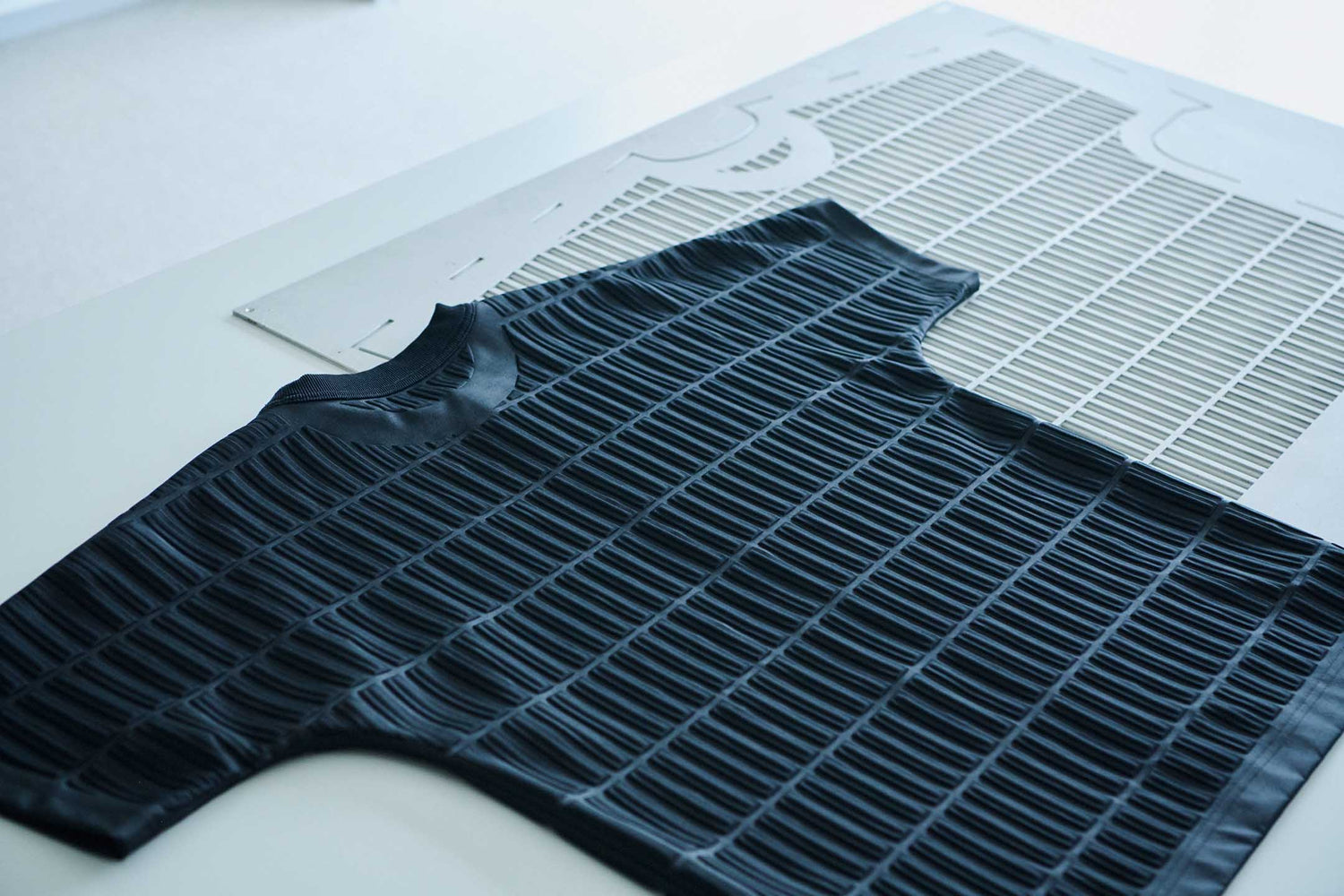
The TYPE-E 001 T-shirt (foreground) and a metal die board used in the manufacturing process (background).
A-POC ABLE ISSEY MIYAKE (hereafter A-POC ABLE) has unveiled TYPE-E 001, a piece that merges the A-POC concept with a distinctive embossing technique long explored by Takashi Mori of LIMIDEA INC. The three-dimensional texture applied to the fabric not only casts alluring shadows when it catches the light, but also minimises contact with the skin, creating a comfortable space within the garment. How could this technique be taken further? Centred on embossing, a technique previously uncharted for A-POC ABLE, this conversation looks back on the process of exploring the possibilities of “a piece of cloth.”
Exploring the Hidden Possibilities of Embossing
— First, could you tell us how this collaboration came about?
Takashi Mori (hereafter Mori): I originally worked at MIYAKE DESIGN STUDIO and Issey Miyake from 1999 to 2005, where I was involved in planning for ISSEY MIYAKE and ISSEY MIYAKE MEN. Among the collections at that time there were pieces with embossing, and I remember being completely captivated by it and struck by what a fascinating technique it was. That was what initially sparked my interest. Even after setting up my own brand, I continued researching embossing independently, and along the way I had the opportunity to speak with Miyamae-san on both a personal and professional level. We then gradually began to consider working together.
Yoshiyuki Miyamae (hereafter Miyamae): Many of those who built their experience at Issey Miyake continue, even after going independent, to hold the approach to making and design in high regard. Mori-san is one of them. Embossing had been used in ISSEY MIYAKE collections before, but it is not generally considered a technique used in garment-making. Nevertheless, Mori-san has continued to engage with this technique from a design perspective.

The interview was conducted with Takashi Mori (right) of LIMIDEA INC., together with A-POC ABLE ISSEY MIYAKE designer Yoshiyuki Miyamae (front left) and engineering team member Takahiro Hoshino (rear left).
Mori: The appeal of embossing is difficult to put into words. To begin with, by applying a three-dimensional treatment to a plain fabric, a pattern emerges without relying on colour. I found something almost mysterious in the way that opposites coexist: the fabric is plain, and yet it has a pattern. And that pattern changes impression depending on the angle from which it is viewed and the brightness of the light.
Beyond the visual beauty and allure, embossing is also a technique worth pursuing over the long term for the complexity of its process. This is because the final result changes dramatically depending on the balance of three factors: pressure, time, and temperature. If the balance among these is not quite correct, the fabric can end up with an undesirable sheen, or it can tear. The most compelling result comes down to the right fabric, the right treatment, and the right balance between them. And finding that has been the subject of more than twenty years of research.
When I began to think about expanding the scale of my research and reaching more people with the attraction of embossing, I realised that there were limits to what I could do alone. But A-POC ABLE had the environment to make it possible, a laboratory-like setting where you can pool ideas with dedicated members of the team and carry out all kinds of experiments, with the means to share the results with the world. And to be able to research once again alongside Issey Miyake, the very place that had first drawn me to embossing, was more than I could have hoped for.
Miyamae: Mori-san says that, but the technique he had already developed was itself of a remarkably high standard. When I saw it at the start of our collaboration, I remember thinking honestly: “Is there anything more that A-POC ABLE can bring to this?” If we were going to research together, we had to develop what Mori-san had so painstakingly built in a way that was true to A-POC ABLE. It was a collaboration that began with that sense of responsibility, and pressure.

Mori obtained a patent in 2020 for an embossing technique that uses urethane dies. During the early stages of developing TYPE-E 001, dozens of urethane dies were produced and tested to study the compatibility between different fabrics and patterns. Pictured are offcuts from the urethane materials used in those experiments.

Takashi Mori of LIMIDEA INC.
Adding an “A-POC ABLE Touch” to the Embossing Technique
— Could you talk us through the process of how this collaboration unfolded?
Takahiro Hoshino (hereafter Hoshino): Mori-san had already obtained a patent for his embossing manufacturing technique in 2020 and had also developed a dedicated metal frame. We began by making sure we properly understood that technique.
Mori: The technique I have patented is, in simple terms, a method that incorporates urethane into the embossing process. To emboss fabric, you normally use a pair of metal boards, one to press and one to receive, in order to create a three-dimensional surface. However, preparing those boards involves considerable cost. This method reduces that cost compared to conventional approaches by combining urethane to serve the role of one of the boards.

When the collaboration between Mori and the A-POC ABLE engineering team began, they first explored the relationship between fabric and pattern in the embossing process.
Hoshino: Mori-san’s approach involved placing fabric that had already been made into a garment shape on a board and pressing a pattern onto it from above. The question for us was how to bring an A-POC ABLE requirement to that process. What we first focused on was the process itself. Central to “A-POC” is the idea of designing patterns and garment structure into the fabric from the outset. So rather than applying a pattern at a later stage, we thought we probably should create a metal board in the shape of a garment and design the pattern within it. But from there it was a continuous process of trial and error. What kind of pattern should be applied to what kind of fabric? And what does it even mean to emboss a garment? It took around a year just to learn that.
— The fact that you spent a full year developing an understanding of embossing suggests a real commitment to working through the process carefully. On what did you place particular importance in this collaboration?
Miyamae: Within the team, there was actually a hope that a younger engineer would take this uncharted technique and develop it further in an A-POC ABLE direction. Until now we had centered our work around “Steam Stretch” and “Baked Stretch,” and there are already seasoned members with a high level of expertise in those areas. So this time, we gave Hoshino the challenge.
Mori: I was also looking forward to seeing what ideas would emerge when a talented young person encountered embossing for the first time. I had been researching embossing for nearly twenty years and there were areas where my thinking had become rigid. So while I wanted to share all the techniques and knowledge I had accumulated without holding anything back, I also wanted Hoshino-san to feel free to choose the patterns and fabrics himself.

Takahiro Hoshino of the A-POC ABLE ISSEY MIYAKE engineering team.
Hoshino: Mori-san and I went to the factory together, and to start we tried embossing around fifty different fabrics, from both the front and the back, to see what results we would get. Eventually I began to associate embossing with mountains, and started thinking about what it might look like to create differences in height, like a mountain range. Something Mori-san had mentioned, that “the shadows created give rise to different kinds of beauty depending on the angle and the light,” was also one of the cues I received. I thought that those shadows would gain greater depth and become even more beautiful if the height varied across two or three levels rather than just one. From there, we began experimenting with how to create gradations and variations in height.
Mori: The idea itself was interesting to me from the start. Since I had always worked on the assumption of single-level embossing, I was genuinely curious about what would happen if you layered the levels. But from there, it was a long road.
Hoshino: When we actually tried it, the pressing pressure was too strong and the gradation was flattened to the point where it was barely visible. In the end, that approach couldn't produce much of a difference in height.
Mori: We kept saying “the pattern isn’t coming through…” as we tried again and again. But looking back, that period of trial and error was a fulfilling one. Having spent so long researching on my own, I was genuinely happy to be able to share the joy of making with a younger engineer. Moreover, it was wonderful that the people at the factory also joined in enthusiastically and supported our experiments.
Hoshino: Consulting with the factory team, we tried all kinds of experiments, like cutting the urethane at an angle to see if pressing it would create more levels. They would offer advice like, “We haven’t tried this on garments, but years ago we used a metal die like this for a different product.”
Mori: Even in the time when I was working there, the Issey Miyake team has always been hands-on, and going to the factory in person really does generate a wealth of ideas.
Miyamae: Engaging in dialogue with the specialists at the factory is something that touches on the very foundation of making things. There are many cases where an idea exists but is genuinely difficult to realise in practice, sometimes the factory will simply say it cannot be done. But if an engineer conveys their passion, they may say, “Let’s give it a try.” There are numerous convenient ways to communicate, but nothing beats meeting face to face. In making things, that kind of trust is indispensable.

Yoshiyuki Miyamae, designer of A-POC ABLE ISSEY MIYAKE (center).
— When you weren't getting the results you had hoped for, how did you shift your perspective?
Hoshino: For the pattern, we decided to go back to basics and adopt the simple punch-board dies that Mori-san had used for many years. For instance, “PLEATS PLEASE ISSEY MIYAKE” continually explores how to make the most of its pre-sewn garments pleated to finish, and “BAO BAO ISSEY MIYAKE” pursues the possibilities of how its triangular pieces can be combined. In the same way, we decided to explore whether new patterns could be created by varying the way Mori-san’s boards were combined. What we were particularly conscious of this time was using shapes that were as simple as possible and that would look natural at any size, much like the triangles of BAO BAO. So, to begin exploring the relationships between shapes, we first made paper models of the metal boards. We worked through them with our hands, examining what patterns would emerge when a large-pattern board and a small-pattern board were combined, and whether the way the pattern appeared would change depending on which was placed on top.

Different shapes were cut from sheets of white square paper to create study models for developing embossing dies.
Mori: After going through that process, the moment a beautiful pattern first appeared on the fabric at the factory, we were both overjoyed, weren’t we. “It came through!”
Hoshino: That was a truly happy moment. We continued testing and gradually narrowed down to the patterns that felt most visually interesting and powerful. Initially I had in mind long, clean lines running through the fabric, reminiscent of pre-sewn garments pleated to finish. But when it came to embossing, the longer the lines, the more prone they were to curving. So we changed approach and tried deliberately cutting the lines partway through, and not only did the pattern stabilise, but a new quality emerged, as if blocks were arranged in neat formation.

After completing TYPE-E 001, Miyamae and Hoshino revisit the experimental process while looking again at the paper study models.
Metal Die as a Declaration of Commitment
— Looking back on the process of this collaboration, what are your overall reflections?
Miyamae: It took nearly two years from the moment we got going, but as a result I feel we managed to establish a clear A-POC ABLE identity in the work. First, we were able to properly design the pattern in relation to the shape of the garment. Beyond that, we managed to achieve both function and aesthetic, drawing out a distinctive beauty while remaining attentive to ease of production on the ground, which is something of fundamental importance in making things.
Mori: I also feel that the embossing technique was developed in a way that is true to Issey Miyake. The fact that the pattern has two levels speaks to the depth of exploration that is the characteristic of Issey Miyake. And there is a refinement in the choice of fabric and the way the embossing is expressed. Above all, when I saw the metal board made for this project, I felt: “Ah! ‘GAUFRAIT’ (A textile brand specializing in embossing techniques by Mori) and ‘A-POC ABLE’ have come together.”
Miyamae: If you approach things from the conventional perspective of garment-making, the instinct is to want to develop a technique across a wide variety of forms. For that reason, investing in a die is rarely done. That is precisely why this metal board is not only a practical object, but it is also an expression of A-POC ABLE’s commitment to continuing things properly.

Mori: I also feel it speaks to the fundamental A-POC concept of “a piece of cloth.” There is a beauty to the metal board itself, almost like a work of art.
— Could you also tell us about the fabric chosen for TYPE-E 001?
Hoshino: After testing an enormous number of fabrics, we settled on a polyester jersey that combines lightness and softness. The reasons for choosing it are that it is comfortable to wear and also excels in terms of functionality, shape retention and quick-drying properties among them.
In terms of comfort, the inherent qualities of embossing as a technique also come into play. The three-dimensional surface of the fabric reduces the area of contact with the skin, and air enters the spaces that sit slightly apart from it, which contributes to a sense of ease. This time the pieces are a T-shirt and trousers, but there are plans to create a jacket and other items going forward. Since the ideal fabric and pattern would differ for each item, we intend to keep researching and developing TYPE-E further.

Miyamae: At A-POC ABLE, even as we explore freely, there are benchmarks we must return to. That garments can be worn across a range of everyday situations, that they can be washed, that they can accommodate diverse body types. And functionality is an important point on the checklist. If, for example, you can put on a jacket, board a plane, and walk straight into a meeting, it becomes a garment that genuinely serves life as it is lived. Thinking along those lines, there is also the need to design for shape retention. How do you meet those benchmarks while making the most of the technique? That is where the difficulty lies, and at the same time, where the greatest interest is found. I believe that Issey Miyake's approach to making things only comes into being when you are willing to think that deeply.
Mori: You have to keep asking yourself what you are trying to achieve through embossing as a technique. If you pursue that question to its conclusion, the answer is to bring happiness to people. And a garment is only truly complete the moment someone puts it on. If, at that moment, there is no sense of necessity, no reason why it had to be embossed, then you cannot say the technique has been truly put to its fullest use. That is what I believe.
Miyamae: Finally, I would like to ask you something, Mori-san. Were there anything that particularly stayed with you from this collaboration?
Mori: Watching Hoshino-san work through trial and error, and seeing his ideas for patterns, I felt that the thinking and the approach I had loved during my time at Issey Miyake were still very much alive and being carried forward. Looking across the fashion world, trends and techniques tend to shift on short cycles of three or six months. But within that, there are many pieces that would be a shame to leave behind after just one collection. Embossing is one of them. Being able to develop this technique with great care and over time, together with Hoshino-san and everyone at A-POC ABLE, has been a source of pure joy.

Takashi Mori
Representative of LIMIDEA INC. Working with the concept of Less Is More + IDEA as his central axis — a method of adding ideas to minimalism — he has been involved as director for numerous companies. While serving as a specially appointed associate professor at Bunka Gakuen University Graduate School, he launched GAUFRAIT, a textile brand specialising in embossing techniques, in 2016 as a case study. He continues to create across a wide range of fields beyond clothing, including interior design, product design, and music.
