



Episode 5
“Designing for Serendipity”
by Kenta Umemoto (Photographer)
There is no shortage of art pieces featuring flowers as motifs. Floral patterns in clothing are not uncommon either. Nevertheless, the dresses and jumpsuits from the “TYPE-VIII Kenta Umemoto project” possess a fascinating beauty; mesmerizing yet ephemeral, a beauty that feels like an inkling of something formless. This project reconstructs the “FLŌRA” series of a rising photographer based in Paris, Kenta Umemoto, into clothing. What story lies behind it? We explore the path of earnest creation through dialogue, blending the inevitable and the accidental, the deliberate and the unintentional, meticulous programming, and physical motion, all crafted by the artist and the design engineers from A-POC ABLE ISSEY MIYAKE.

“I want to bring out the potential that resides in each individual flower.” This is how Kenta Umemoto describes his intention as a photographer who continues to engage with flowers. Starting in around 2018, he began producing a series of studies at home, which later became a series titled “FLŌRA.” The experimental and beautiful images, which combine digital and analog techniques, have quietly garnered a circle of admirers. One such who found a connection with the work was A-POC ABLE designer, Yoshiyuki Miyamae.
The two eventually met, and together with the engineering team, they began a project that culminated seamlessly in the release of the “TYPE-VIII Kenta Umemoto project” this fall. Creative dialogues and processes of course have been ongoing behind the scenes, but this time, the conversation goes even further back.
Kenta Umemoto is a photographer whose future is highly anticipated. He moved to France in 2020, and despite the pandemic, has been relentless in his pursuit of his unique mode of expression. So asking about his past and his thoughts is important not only for gaining a deeper understanding of the collaborative “TYPE-VIII” project, but also to give an insight into the future aspirations of this emerging artist.


──When did you start expressing yourself through photography? And how did it all begin?
Kenta Umemoto (“Umemoto” below): I started exploring photography when I was a university student. The university I attended offered a course on photojournalism and I took it by chance. I found the content of the course quite interesting, and I started wanting to become something like a war photographer or photojournalist. I immediately went to Ueno to buy a camera and began attending workshops my professor was running at the time.
After that, I traveled to several countries with a Canon digital SLR, covering topics I chose myself, like environmental issues in tropical regions. I did research, took photos, and wrote articles. I was around 19 or 20 years old and was full of energy, trying out all sorts of things. I probably had the mindset of, “I’m a photojournalist,” but looking back now, it was just an illusion. I didn’t really understand what true journalism was at the time.
──Even so, were you so absorbed in photography that you considered becoming a professional photographer?
Umemoto: I did want to pursue photography, but it still wasn’t a concrete idea. Then the Great East Japan Earthquake happened, and while my friends and acquaintances who were into photography all went to the disaster areas to shoot, I couldn’t bring myself to move at all. I instinctively didn’t want to do it, and I couldn’t. I felt frustrated but I was also going through a rough time both physically and mentally, which was part of the reason. In the end, though, I realized that the nature of the job, taking disaster photos to sell to news agencies and media, just didn’t sit right with me.
Soon after, I began studying film photography and I realized this was what I really wanted to do. From then on, while attending university, I researched through books and the internet and attended short courses to experience working in a darkroom. I pursued photography in what felt like a double or triple schooling alongside my student life. I spent a lot of money on equipment, materials, and courses, so I did numerous part-time jobs to support myself.
──Why did you want to pursue photography itself, rather than journalism, to such an extent?
Umemoto: Indeed, I wonder why. To be honest, I still don’t know the exact reason why I’ve latched onto photography so much. I simply enjoy creating images and taking pictures, but if you asked me why I like it, I’d have trouble answering (laughs). It’s not that I love cameras; in fact, I have a rather indifferent attitude toward equipment—anything will do. I guess I keep doing what I find interesting, and because I’m doing it, I like it.
Yoshiyuki Miyamae (“Miyamae”below): After you moved away from journalism and began focusing on expression, what kind of photograph were you taking on film when you were in university?
Umemoto: I was taking photos of streets and people. I didn’t have any specific themes, but back then, film wasn’t as expensive as it is now, so I was shooting a variety of subjects and developing the photos myself. I set up a simple darkroom in my kitchen, leaving just the gas stove so I could cook. I was obsessed with shooting, developing, and printing film in all formats, from 35mm to medium and large format.
──At that time, were there any particular photographers or artists you admired, or who influenced you?
Umemoto: My university was in Jinbocho, Tokyo, so I spent a lot of time looking at photo books in second-hand bookstores. One photographer who left a deep impression on me was Keiichi Tahara. His work with light and shadow really resonated with me and I admired his versatility, not just in photography but in expressing himself across various fields. I also looked up to him for being a Japanese artist based in France. Years later I had the opportunity to have a meal with him, and as we talked, I got so emotional that I started crying (laughs).
──What did you do after graduating from university?
Umemoto: I graduated about six months later than expected and after that, I did all sorts of part-time jobs. I wanted to work in photography, but I couldn’t find any shooting assignments at the time. Eventually I heard about a kimono company based in Yamagata that was looking for a photographer to open a photography studio in Tokyo. I think they approached me partly because we were from the same hometown.
I thought it sounded interesting and it was after all photography work, so I decided to accept the offer. I was mainly photographing commemorative portraits for events like Coming-of-Age ceremonies. Since it was a photo studio run by a kimono company, I would photograph people dressed in kimonos, along with the kimonos and the fabrics. Essentially it was standard portrait photography which was taken on my marks of something like, “Alright, smile for the camera!”. In the end, I worked there for five years, and I must have photographed about 4,000 groups in total. It was non-stop shooting of people and fabrics. Now that I think about it, it was great training and has become the foundation of my current work.
──I imagine lighting techniques are important for studio photography. Did you learn those somewhere before?
Umemoto: Lighting is very important but actually I learned everything on my own. You can find a lot of information online, and there’s quite a lot you can learn about equipment usage from the internet. I guess it’s just in my nature, but I always try to study and figure things out on my own first. If there’s something I don’t understand, then I ask someone for help. Whenever I received enquiries, I would always respond with, “Yes of course, I’ll do it.” If I didn’t know how to do something, and in fact there was a lot I didn’t have a clue about at first, I would rush home and study it. That’s how I gradually brushed up on my lighting and photography skills.
──That seems like a very unique approach. I’ve often heard that people usually take on an apprenticeship at a studio or with a photographer to learn lighting.
Umemoto: Yes, it might not be the conventional way to advance in this field. In the end, I didn’t study under anyone; I learned everything on my own. In hindsight, I think that was for the best and it’s led me to the work and activities I do now. Of course there were times when I thought maybe I should study under someone. But I didn’t like the idea of begging seniors for advice or being part of a group. I wanted to try things myself first. I had a belief that I could learn through my own experience. Looking back, I might have been a bit cocky (laughs).
──It sounds like you have had a strong sense of independence and self-reliance. That seems like a crucial quality for an artist but it could also lead to risks like making mistakes.
Umemoto: In fact, if you count the small things, I think I’ve made many mistakes. Of course there are times when I look back and think, “I should’ve done it this way,” and I sometimes dwell on things, but I don't let them weigh me down. I tend to focus more on figuring out why I failed, reflecting on it, and turning that into a learning experience. Maybe that’s why I don’t really have a strong sense of “failure.” My approach is more like, “I’ll just try again.”
Needless to say, I was aware that I lacked experience and knowledge, so I always prepared very carefully before each shoot. I would thoroughly research everything beforehand and then walk into the studio as if nothing was wrong, staying cool and shooting like a pro photographer (laughs). That was the style I stuck to.
──I can sense a strong determination to continue learning and exploring your own form of expression as a photographer.
Umemoto: Yes, I’m always hungry for that. If there’s something I want to see, I chase after it until I can see it. If there’s something I want to do, I’ll make sure I do it without holding back. I have a big appetite for food, too (laughs). There’s a lot of pressure but confronting it makes me stronger. Facing work and creative projects alone, carrying the responsibility and trying to produce something, these might be a result of that hungry mentality.
──And this hunger seems like a quality suited for a photojournalist.
Umemoto: I wasn’t that hungry when I was a university student. I don’t think that hunger is deeply rooted in me. I think it comes from a desire to express the images, the beauty, the emotions, and the feelings I have inside through photography and visuals. Maybe the direction of my hunger is just different.

──You’re currently based in Paris. What led you to move to France?
Umemoto: While I was still working at the photo studio, I received an email from a French creative director about photoshoot commissions out of the blue. The first job was for Shiseido and from there I started photographing products as well. Through those opportunities, I began photographing a wide variety of subjects. As I had always wanted to pursue my career as a photographer on a global scale, I began creating personal work after I came home from the photo studio job and have gradually built up my portfolio.
In 2019, I got married and I was able to take time off from the photo studio for a honeymoon. I took my portfolio with me and went to Paris with my wife. I arranged meetings with agents and visited about five or six offices. One of them which represents many prominent global artists ended up becoming the agency I’m currently signed with. I didn’t think it was possible but I managed to get the contract. Once you have a contract, it opens the door to obtaining a multi-year visa, so I knew I had to go. I quit my job at the photo studio and moved to Paris in 2020.
──At the time when your career in Japan was starting to grow, you were already looking overseas and taking solid steps to make it happen.
Umemoto: I wasn’t satisfied with working just in Japan. I wanted to engage with the world. And the more photography work I did, the clearer my goal became of becoming a photographer who could play an active part on the global stage. That meant not going back and forth between Japan and abroad in a half-hearted way, but fully committing to working internationally. I started focusing on how to become a photographer who could thrive in that environment. So it was just a matter of taking action.
──You moved to France in 2020, when the pandemic hit. That must have had a big impact on your plans.
Umemoto: Indeed. In January 2020, initially I was supposed to move by myself after I vacated my home in Tokyo. There were some delays in getting my visa, so I couldn’t actually enter France until late February. Then about two or three weeks later, the pandemic started spreading across Europe and France then suddenly announced a lockdown, forcing me to return to Japan. I ended up spending seven months living at my wife’s family home in Yamagata. Since I had no work during that time, I spent all my time photographing flowers.
Then in October, I was finally able to travel again and return to Paris. The first one or two years, however, were incredibly tough. It was a real survival experience. My contract with the agency was on a freelance basis so there were no guarantees of jobs. I had to hustle and get work on my own. But since we were in the middle of a pandemic, even going outside required a permit and it was difficult to go around promoting my portfolio. The only thing I could do was to keep creating and putting work out there. I focused on making new pieces, posting them on Instagram, and compiling them into PDFs to send to potential clients via my agent.
With no income, my wife and I lived in a small apartment, carefully using up our savings and cutting back on everything. Every day, I would compare our savings with living costs and rent, calculating how much longer we could afford to live in Paris. I came to Paris to pursue photography, and I couldn’t afford to lose focus on that goal. I was determined to protect the fact that I was, above all else, a photographer, no matter what.
──It sounds like a really challenging start, almost like a period of apprenticeship.
Umemoto: That first year I probably had just one job, if any at all. Looking back now, I can say that I needed to go through that experience and that those tough times were beneficial in their own way. But at the time, it really felt like hell. (Laughs) Still, because the situation was so hard, I had nothing else to focus on except my own work. And with all that time on my hands, that’s when “FLŌRA” really started to develop.
──It’s fascinating how things work out. The flower-themed “FLŌRA” series you created was actually spotted by Miyamae-san.
Miyamae: Yes, I happened to come across Umemoto-san’s work on an art and design media source. It must have been around 2021, I think. I remember being really struck by how incredible his photos were. About a year later, I got a message from someone at that media outlet saying they wanted to introduce me to someone, and it turned out to be Umemoto-san.
Umemoto: After about two years of working in Paris, I finally reached a point where I could afford to pay for my own trip back to Japan. Since I was returning, I wanted to meet and talk with people who resonated with me creatively, so I sought advice from someone I trusted. Miyamae-san’s name came up straight away and I was given his contact details. I then sent him an email.
Miyamae: I remember that. We met at the Issey Miyake office, where Umemoto-san showed me his work. We talked about what we were both working on at that time. Then about a year later, in February 2023, we had another chance to meet, this time in Paris. In 2022, I created costumes for a stage performance using a technique that involved pressing gold leaf onto the clothing. But I had this sense that there was a way to elaborate on this method without relying just on gold leaf. That’s when Umemoto-san suddenly came to mind! (Laughs)
Umemoto: I seem to recall you even said, “You appeared in my dream,” right? (Laughs) Maybe I sent you some kind of subconscious signal. That’s when, in the spring of that year, I returned to Tokyo for an assignment and then had the chance to meet with Nakatani-san and Takahashi-san from the engineering team. That’s when this project started to take shape.


──At the beginning of this project, what were your thoughts as a design engineer?
Manabu Nakatani (“Nakatani” below): We had already been exploring how to enhance Steam Stretch with different forms of expression. We already knew that printing on pleated fabric could produce beautiful effects. But without a narrative or deeper visual story behind the colors and patterns, it would just be another beautiful fabric and therefore taking it further was the challenge. So with Steam Stretch, I have mostly been focused on the material itself and the technical processes involved.
When Miyamae-san showed me the “FLŌRA” photographs, I was struck by their overwhelming beauty. I felt that through the Steam Stretch technique, with its pleats and folds, we could highlight and even enhance the contrast of that beauty. I just felt that there was a strong potential to express it as an incredibly simple yet elegant garment.
Nanae Takahashi (“Takahashi” below): I remember when we first met Umemoto-san, we looked at his photographic images and discussed what kind of garment piece might suit the project. Once Umemoto-san was back in Paris, he sent us several new works, and we selected the ones that would work best on our end to create samples. Despite the distance between Tokyo and Paris, everything progressed surprisingly smoothly.


Umemoto: In September, when the A-POC ABLE team came to Paris, they showed me the garments which were already completed. The entire process of making the garments, and the garments themselves, were unlike anything I’d ever seen. It was amazing, almost like a Polaroid photo, where the garment emerged from the paper as it was peeled away.
Takahiro Hoshino (Hoshino): We knew that for the “FLŌRA” series, Umemoto-san had been experimenting with both analog and digital techniques, so we initially tried several different approaches to processing and printing. Eventually, we found that heat transfer printing best preserved the vivid colors of the photos, so we chose that method.


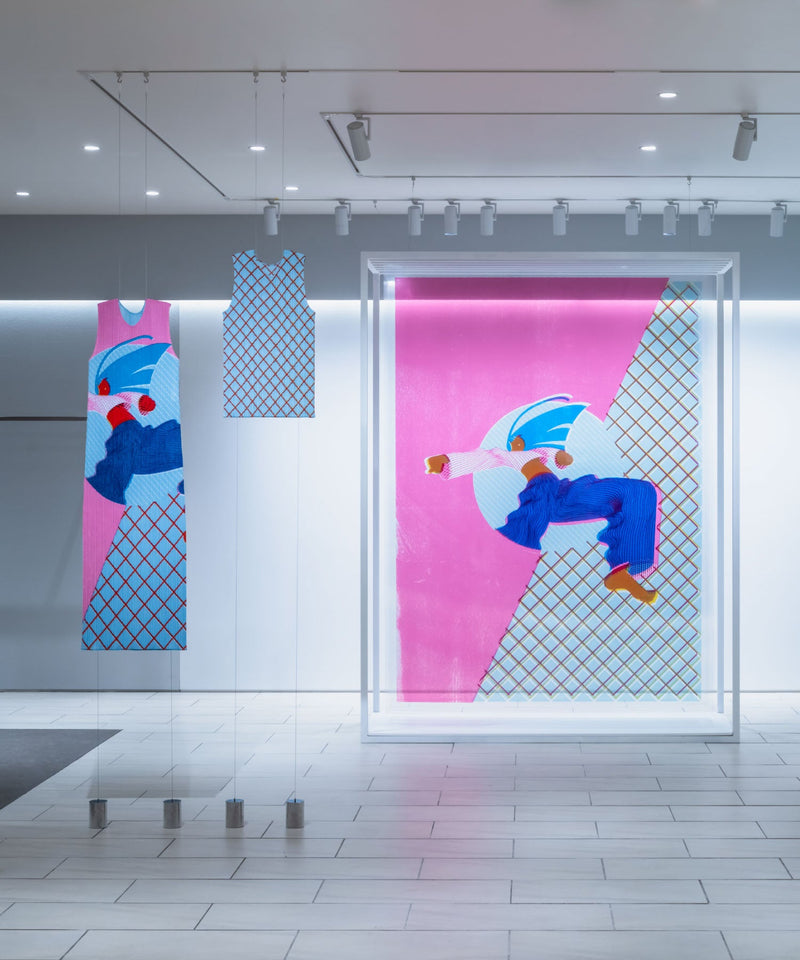
The process begins by creating a white garment with pleats and folds using the Steam Stretch technique, resulting in a highly three-dimensional piece. We press it flat, then once that’s done, the garment is sandwiched between transfer paper that holds Umemoto-san’s photograph. By applying heat and pressure, the image is transferred onto the fabric. When the paper is peeled away, the printed garment emerges. Though the print is initially applied on a flat surface, we paid meticulous attention to maintaining the beauty of the garment’s three-dimensional structure, including its silhouette and collar design.


──It looks like you have transferred the artwork in a way that it’s been trimmed depending on the clothing.
Takahashi: We tried various adjustments such as changing the size and position of the images and determining how much white space to leave. Interestingly, as we selected what we felt looked best, we ended up gravitating toward similar outcomes.
Nakatani: What was memorable to me is when I asked Umemoto-san if it was okay to crop the pieces, he simply replied, “Anything goes.” Since it’s a piece of art, for us there’s always a certain hesitation to rotate or cut it. When I timidly inquired, he said, “You can rotate it 180 degrees, shrink it, enlarge it, or crop wherever you think it looks beautiful. Feel free to do as you like.”
Umemoto: Well, if you just want to have a look at my photographs, you can simply visit my website. Since the goal here is to create garments, not just showcase the photos. I believe it’s best for the A-POC ABLE team to express their ideas freely. So it doesn’t feel right to me to impose strict instructions. That would limit their creativity, and I find that uninspiring.
This project is a collaborative effort, so allowing everyone to output their best work strengthens the final result. I put my heart into creating the original artwork, so I want to allow the freedom to express that in the garments. I also entrusted everything to the A-POC ABLE team and I felt confident in their capabilities. Ultimately, both photography and fashion are human creations, and how we connect as people and as a team is what matters most.

──Going back a little, could you explain the overall concept behind “FLŌRA”?
Umemoto: The foundation of “FLŌRA” is the flowers I photographed, but the theme revolves around the layered processes that evoke a sense of beauty in flux. As a photographer, I often feel there are limitations to the act of photography, and I constantly think about how to transform them into more painterly expressions. By layering physical processes over the photographs, I aim to foreground elements like distortion, glitch, or even failures. This approach allows me to reshape the images into what I envision. Rather than manipulating visual materials on a computer monitor, I focus on utilizing the effects that arise from manual processes, creating images that are imperfect yet perfect in their own right in the end.
──By intentionally incorporating errors from handwork, the sense of beauty becomes fluid. When you are creating a piece of work, do you follow a process of shaping a clear vision into reality?
Umemoto: I guess so. I normally have a clear vision and do some planning, but things rarely turn out exactly as I envision. Although I usually do detailed sketches, strangely, the results often feel more beautiful than what I originally imagined. Developing several patterns is important, but so is the task of refining them. The whole process takes quite a bit of time.
Takahashi: Our approach to making things is quite similar. We prepare all materials and methods to take to the site, but more often than not, the results are things we hadn’t anticipated. Since we experiment extensively, we’re fortunate to have long-standing collaborators on-site that share a common aesthetic sensibility. This allows us to converge on what we feel is the best outcome, even amid all the experimentation.
Nakatani: In this project, the pleats created through Steam Stretch are designed to generate a sense of white space in the photographs. Umemoto-san’s process includes generating errors through physical techniques, and the key point for us was how to express the accidental beauty that emerges in clothing.
That said, the precision of Steam Stretch is incredibly accurate, so the fabric and the pleats themselves don’t allow for randomness. Everything about how each part contracts is pre-programmed, meaning errors cannot occur. But this time for the image transfer process, there’s a method where we flatten the three-dimensional forms, allowing for slight discrepancies and ambiguities introduced by handwork. This creates a sense of serendipity or a fluctuation in expression. In other words, behind the coincidence, there are inevitable pleats and folds created by a precise program. This duality allowed us to merge the beautiful imagery of flowers with the garments effectively.
Umemoto: That’s a great explanation. If the photographs were just printed without the process you have just described, the garments wouldn’t have emerged in this way. Even though I created the original works, it feels like they’ve been infused with a completely different and new life.
──I understand that you also handled the visuals for the “TYPE-VIII Kenta Umemoto project”?
Umemoto: Yes, because each aspect of the project is all interconnected, I was responsible for everything from shooting to post-production, including how to express the project. I utilized techniques from the “FLŌRA” series while crafting the photographs, allowing the project to be presented as a singular artwork. My wife modeled for the shoot, and we meticulously prepared together to determine how to showcase the garments beautifully and what movements would enhance that.
Miyamae: We shot in a studio in Tokyo, and the lighting was quite fascinating. Naturally, the synergy with the model, Risa-san, was perfect. If it had been someone else, the visuals would not have turned out the same way. The expression turned out to be very strong, and I believe it came together beautifully as a project with Umemoto-san. As the rest of the project has now been presented as a photo exhibition, I hope many people will come to see it.
Umemoto: Since Miyamae-san wanted to print large, I’ve maximized the size up to the limits of the lab. I really hope many people will experience it.

“TYPE-VIII Kenta Umemoto project” exhibition
ISSEY MIYAKE GINZA | CUBE
Period: Sunday, September 1 - Monday, October 28
ISSEY MIYAKE SEMBA | CREATION SPACE
Period: Sunday, September 1 - Saturday, October 26

KENTA UMEMOTO
Kenta Umemoto is a Japanese photographer based in Paris. He first encountered photography through a lecture whilst a student at Meiji University, then later began taking still lifes for a traditional Japanese kimono company and Shiseido. His visual interests expand across beauty, flora, and landscapes. Taking inspiration from vivid colors or Japanese ukiyo-e and manga, he is now developing an original style at the intersection between photography and painting.
